
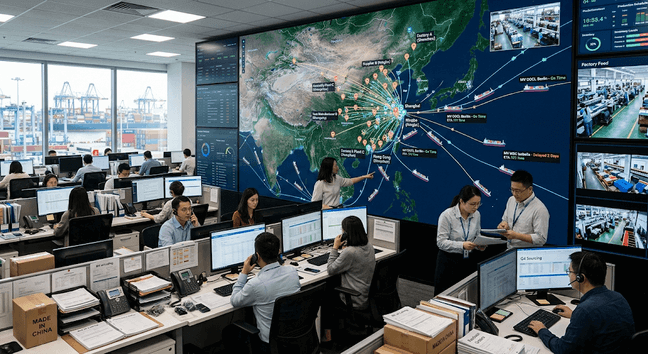
You’ve got more than one supplier in China, and you’ve stopped assuming they’re all fine just because the last shipment was.
Somebody on your team is already spending real hours chasing suppliers for updates, because nobody else is going to.
A supplier problem doesn’t stay a supplier problem — it turns into a customer conversation you didn’t want to have.
You’ve had at least one shipment where what arrived wasn’t quite what you approved, and you’re still not sure how it happened.
You’ve thought about hiring someone in China, or already have someone, and it’s still not quite covering what you need it to.
If two or three of those sound familiar, keep reading.
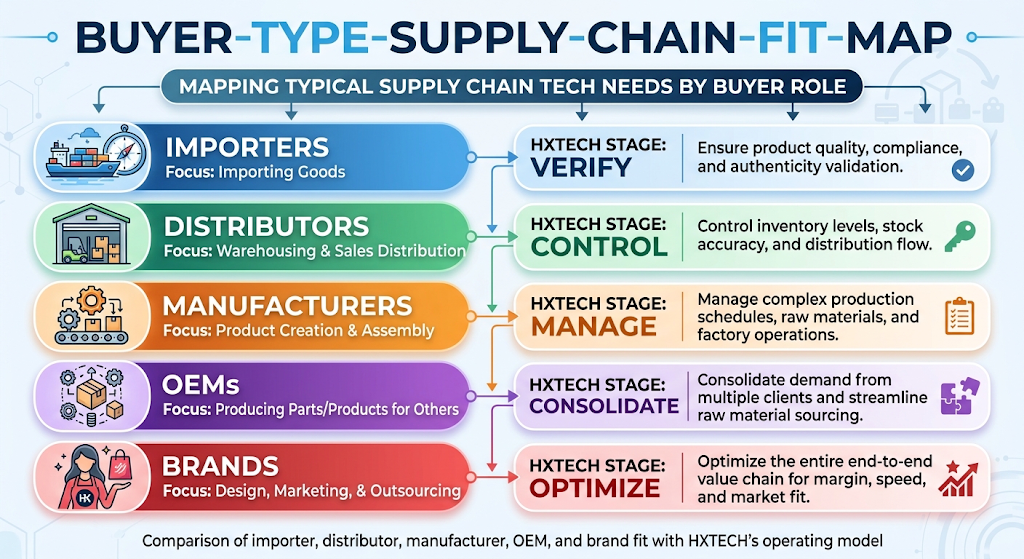
Who this usually is: A business built around bringing product in from China and selling it on — wholesale, retail, e-commerce, or a mix. Typically somewhere between a handful of containers a year and a program complex enough that one person can no longer track it in their head.
Where it usually breaks: You’re buying from suppliers you may have never met in person, on payment terms that assume everything goes as agreed. When it doesn’t, you find out after the deposit is gone, sometimes after the goods have already shipped.
What they usually need first: Verify — knowing who a new supplier actually is before the first order goes out. Control — catching a quality miss before it’s sitting in your warehouse instead of after.
Distributors
Who this usually is: A business carrying a wide product range across multiple categories, often multiple China suppliers per category, selling into a network of retailers or accounts that expect consistent stock and consistent quality.
Where it usually breaks: Breadth is the problem. Twenty SKUs from twelve suppliers means twenty different points where something can go sideways, and most distributors don’t have the headcount to watch all twelve at once.
What they usually need first: Manage — coordinating multiple suppliers without it consuming someone’s whole week. Consolidate — combining fragmented shipments instead of paying for five partial containers.
Manufacturers
Who this usually is: A company that manufactures domestically or assembles elsewhere, but depends on China for components, materials, or sub-assemblies that go into their own product.
Where it usually breaks: A component problem doesn’t show up as a component problem. It shows up on your own production line, as a delay or a defect you have to explain to your own customers — and by then it’s your name on it, not the original supplier’s.
What they usually need first: Control — production monitoring on the component before it reaches your line. Verify — knowing your Tier-1 component supplier isn’t quietly depending on a Tier-2 or Tier-3 source you’ve never heard of.
Brands
Who this usually is: A company that owns the product design and the customer relationship, but doesn’t own the factory — production is fully outsourced to China-side manufacturing partners.
Where it usually breaks: You handed over a design and a spec. What you get back is whatever the factory interprets that spec to mean, unless someone is checking. And once it ships, the brand’s name is the one taking the customer complaint, not the factory’s.
What they usually need first: Verify and Control together — confirming the factory can actually build to spec, then checking that it’s still building to spec once volume production starts.
OEMs
Who this usually is: A business running multiple product lines or multiple client programs at once, often with several China-side suppliers per program, and specifications that vary project to project.
Where it usually breaks: Complexity compounds. Different specs, different suppliers, different timelines, running in parallel — one missed checkpoint on one program is easy to lose track of until it’s already late.
What they usually need first: Manage — coordination across suppliers and programs, so nothing depends on one person’s memory. Control — checkpoints that hold regardless of which supplier or which program.
Different products, same shape of problem. Buyers who fit HXTECH usually share most of this:
Scale. Enough volume, SKU count, or supplier count that one person can no longer hold the whole picture in their head — commonly somewhere between a handful of active suppliers and dozens, and an annual China spend that runs from the high six figures into eight figures.
Real exposure. A meaningful share of revenue, margin, or customer commitments depends on China-side execution going right. If a shipment slips, it’s not a rounding error.
Multiple suppliers, not one. The moment you have more than one factory, coordination becomes its own job — one that usually isn’t anybody’s actual job title.
No dedicated person on the ground. You might have a sourcing agent, a freight forwarder, or someone doing check-ins by video call. What you don’t have is someone whose job is to independently verify and control execution on your behalf.
A decision-maker who’s already felt the cost. Usually a founder, head of procurement, or supply chain lead who has personally dealt with a bad shipment, a missed deadline, or a supplier surprise — and would rather not do it again.
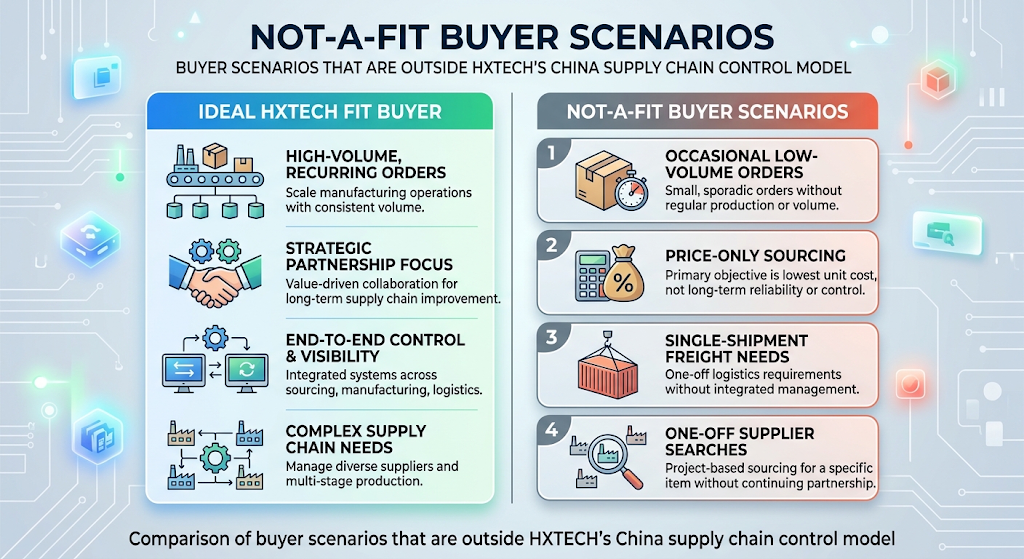
• Very low-volume or occasional buyers. If you’re placing one small order a year, the cost of independent verification and control usually doesn’t make sense yet. A good inspection company for a single shipment will serve you better.
• Price-only buyers. If the only question that matters is “what’s the lowest unit cost,” we’re not the right fit — our value shows up in avoided cost and avoided risk, not in negotiating your invoice down.
• Freight-only needs. If everything about your supplier relationship is already solid and all you need is a forwarder to move a container, that’s a freight company’s job, not ours.
• One-time sourcing projects. If you need someone to find you a single supplier for a single product and then you’re done, that’s a sourcing agent’s job. We’re built for buyers with an ongoing China-side operation to manage, not a one-off search.
• Dropshipping or per-unit fulfillment models. Our model assumes bulk production, quality control, and shipment consolidation — it doesn’t map well onto per-order fulfillment.
• Requests for a supplier list. If what you actually want is “give me five factories that make this,” that’s a directory service, not what we do. We verify and control suppliers you already have, or help you evaluate specific candidates — we don’t run a supplier marketplace.
None of this is a judgment on the business. It’s just a different problem than the one we’re built to solve.
Before you request a review, ask yourself these — they’re the same questions we ask internally when we take on a new buyer.
When do you find out about a supplier problem — before it ships, or after your customer complains?
Do you know, right now, whether your two “backup” suppliers actually share the same material, region, or port?
Who on your team would notice first if a factory quietly changed a material or a process?
How long would it take you to activate an alternative supplier if your main one went dark tomorrow?
Can you put a real number on what a bad shipment cost you last time — not just the unit price, but the rework, the delay, and the customer fallout?
If more than one of those doesn’t have a confident answer, that’s the gap we work in.
See How It Works — the five-stage model (Verify, Control, Manage, Consolidate, Optimize) explained in detail
Explore Solutions — the specific services under each stage
Proof — the evidence and methods behind what we claim /proof/
About HXTECH — who we are and why we operate this way